A Dictionary of Modern Mental Models: Tools for Advanced Intelligence

Table of Contents
A Dictionary of Modern Mental Models #
Take up handy weapons and align with advanced intelligence.
This is a thinking tools book for the present and future, condensing interdisciplinary core concepts and models into entries that can be immediately applied. Each entry is a powerful tool for understanding the world, making decisions, and creating value. The book provides not only definitions and sources, but also practical guidance and key insights, helping you quickly master advanced cognitive methods in work, study, and life. Whether you are a professional, entrepreneur, manager, or explorer seeking to expand your cognitive boundaries, this dictionary can be your portable toolbox of ideas.
Pick it up and you’ll find: complex problems can be broken down, the unpredictable world can be navigated, and your thinking will be freer and more efficient than ever.
Preface #
When making decisions in a complex world, what people often lack is not information, but tools.
The same thing, understood with different mental tools, can yield completely different conclusions. Some see emotions, some see structure; some see appearances, some see mechanisms. Often, the root of cognitive gaps between people is not intelligence, but whether one has mastered a set of effective thinking tools.
This Dictionary of Modern Mental Models is a systematic compilation of these tools. It selects representative concepts from modern science and thought systems, such as the Kelly Criterion, non-ergodicity, and field theory. They come from physics, economics, cognitive science, information theory, and complex systems research, but also have broad explanatory power and practical value in real life. As the “100 Lectures on Modern Thinking Tools” course is updated, these dictionary tools will continue to increase and update.
Each entry includes four parts: source, definition, application, and insight, aiming for a concise structure to help you quickly grasp a core idea and apply it in real situations.
This dictionary does not aim to provide all the answers, but to offer you a better set of questions. When facing complex problems, these tools can help you build models, identify key variables, and understand causality, so you can see the world more clearly.
The way you understand the world often determines the way you act.
And mental tools are the bridge between understanding and action.
General Worldviews #
First: Narrative
This world is not a pile of facts, but a field of narratives; you must both step out of others’ stories and learn to set your own.
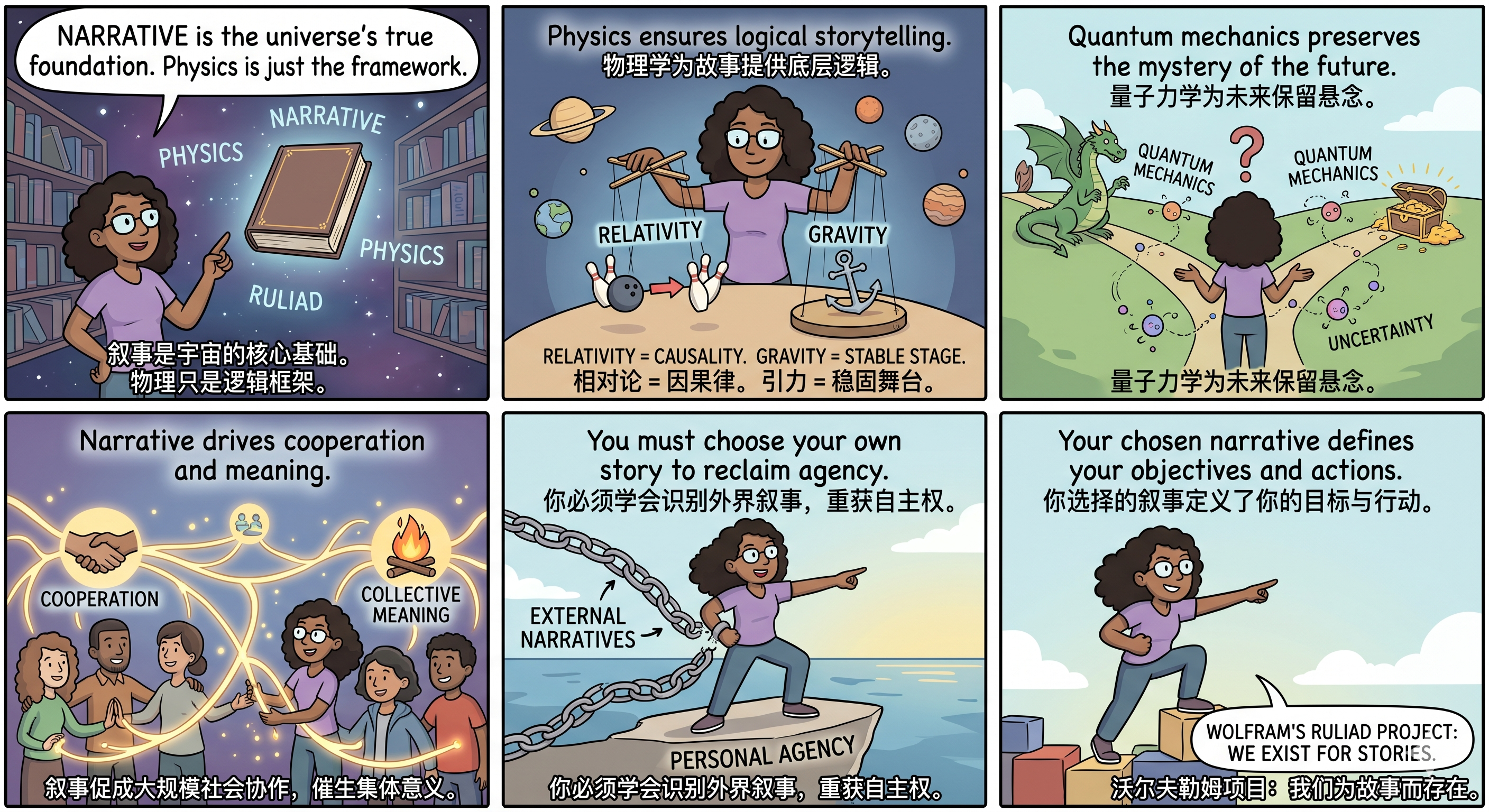
Narrative forms the fundamental bedrock of the universe, with physics providing the essential logic for storytelling. While relativity ensures causality and gravity stabilizes the physical stage, quantum mechanics preserves the uncertainty of the future. Through predictive processing, narrative drives human cognition, generating collective meaning and enabling large-scale social cooperation. However, because every narrative is inherently subjective, individuals must learn to identify external stories to reclaim their personal agency; ultimately, the narratives we choose define our objectives and actions.
In 2020, Stephen Wolfram launched the Wolfram Physics Project, proposing a radical theory regarding the universe’s origins. By treating the universe as a computational “Ruliad,” Wolfram argues that narrative serves as the ultimate first principle, suggesting that physical laws exist solely to facilitate coherent storytelling. In this framework, relativity provides essential causality and a stable stage, while quantum mechanics offers necessary future uncertainty. Within this structure, human consciousness functions as a narrative center of gravity—we exist simply because our universe allows for stories to unfold.
Second: Heavy Tail
This world is not evenly distributed, but full of extreme emergence; don’t get stuck in an additive world, seek multiplicative strengths and compound interest.
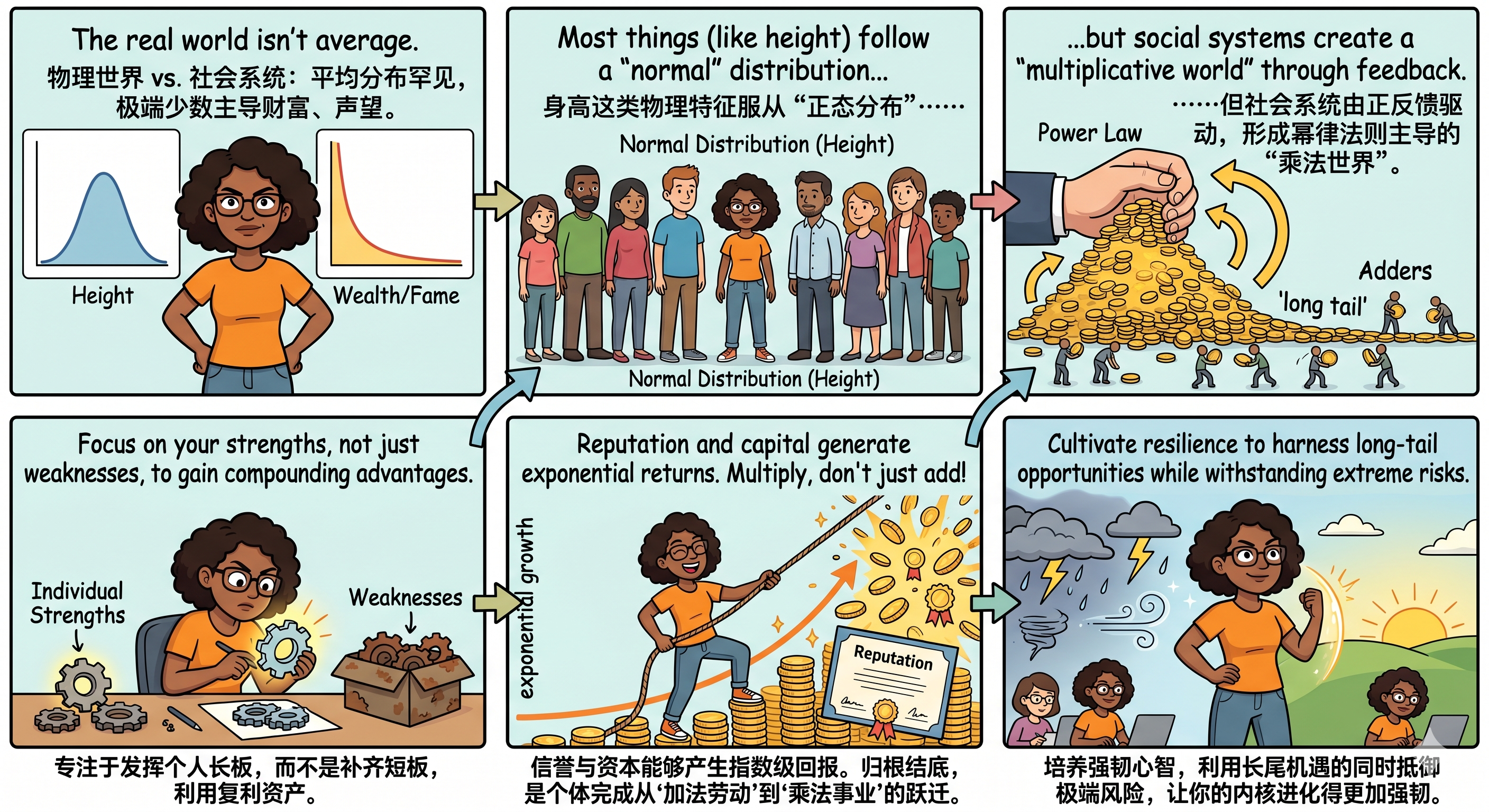
The real world rarely adheres to average distributions; rather, extreme minorities tend to dominate wealth, fame, and innovation—a phenomenon known as heavy-tailed distributions. While normal distributions apply to physical traits like height, social systems are governed by power laws driven by positive feedback. This dynamic creates a multiplicative world where existing stocks continually amplify future gains. Consequently, achieving success requires focusing intensely on individual strengths rather than merely fixing weaknesses, as compounding assets like reputation and capital generate exponential returns. Ultimately, individuals must transition from additive labor to multiplicative ventures, cultivating the resilience needed to harness long-tail opportunities while weathering extreme risks.
Third: Agency
This world is already highly volatile, but old ideas still lag behind; don’t take steady-state survival logic as truth—be an agent, not a tool of old narratives.
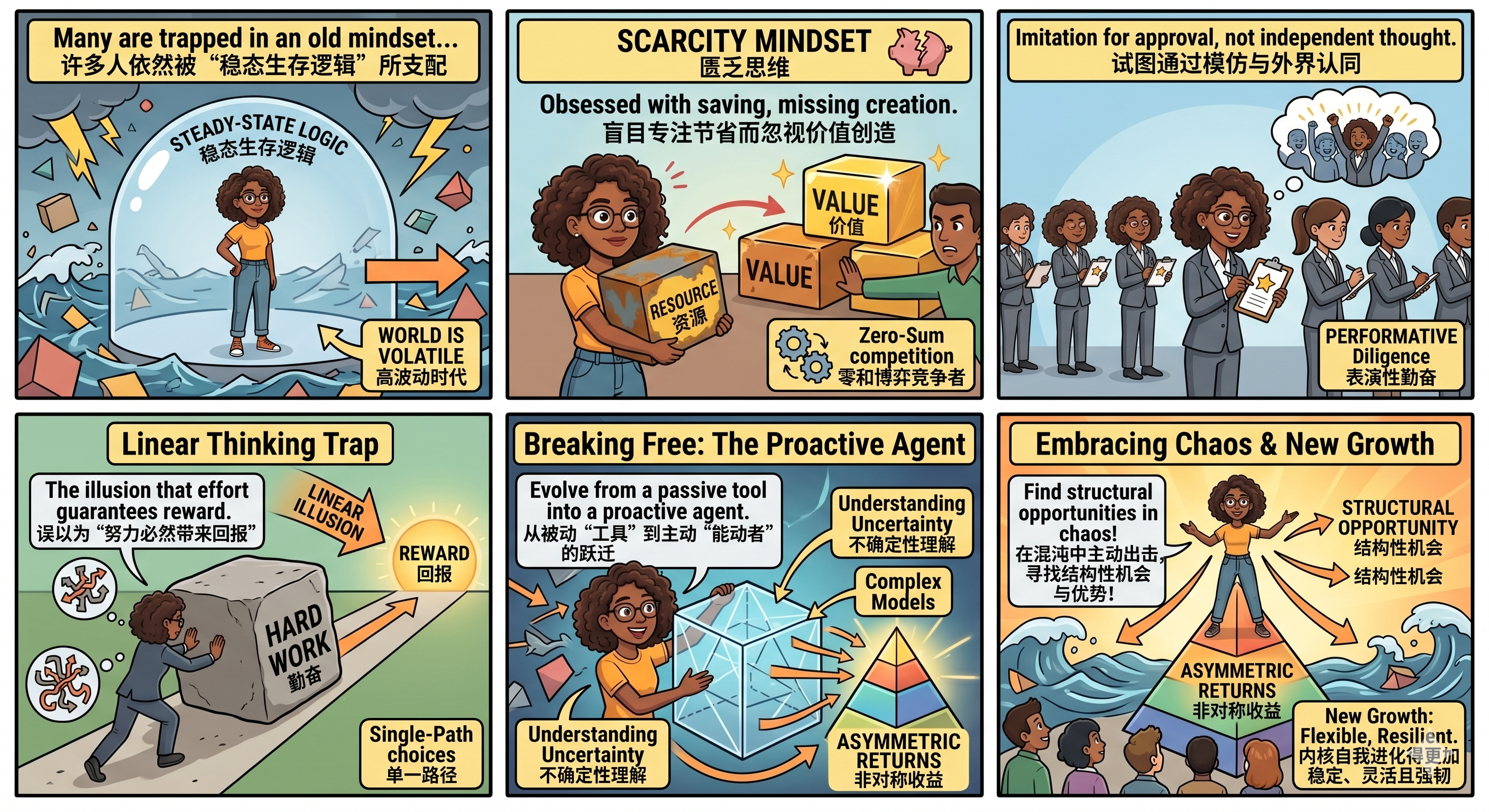
Although the world has entered an era of high volatility, many people remain trapped in a “steady-state survival logic” driven by scarcity, conformity, and simplistic mental models. This scarcity mindset breeds excessive risk aversion, causing individuals to obsess over saving rather than creating value, while viewing others merely as competitors. Compounding this is a conformity born of insecurity, where people seek approval through imitation and performative busyness—gaining short-term stability at the severe cost of independent judgment. At an even deeper level lies the trap of linear thinking: the illusion that hard work guarantees reward, which locks people into rigid, single-path choices and blinds them to complex, asymmetric returns. To break free from mediocrity, one must evolve from a passive tool into a proactive agent by understanding uncertainty, applying complex models, and actively seeking structural opportunities amidst the chaos.
Fourth: Constraints
This world is not a wish-fulfillment machine, but a web of hard constraints; all actions must first assess resources, look for windows, respect rules, and acknowledge others.
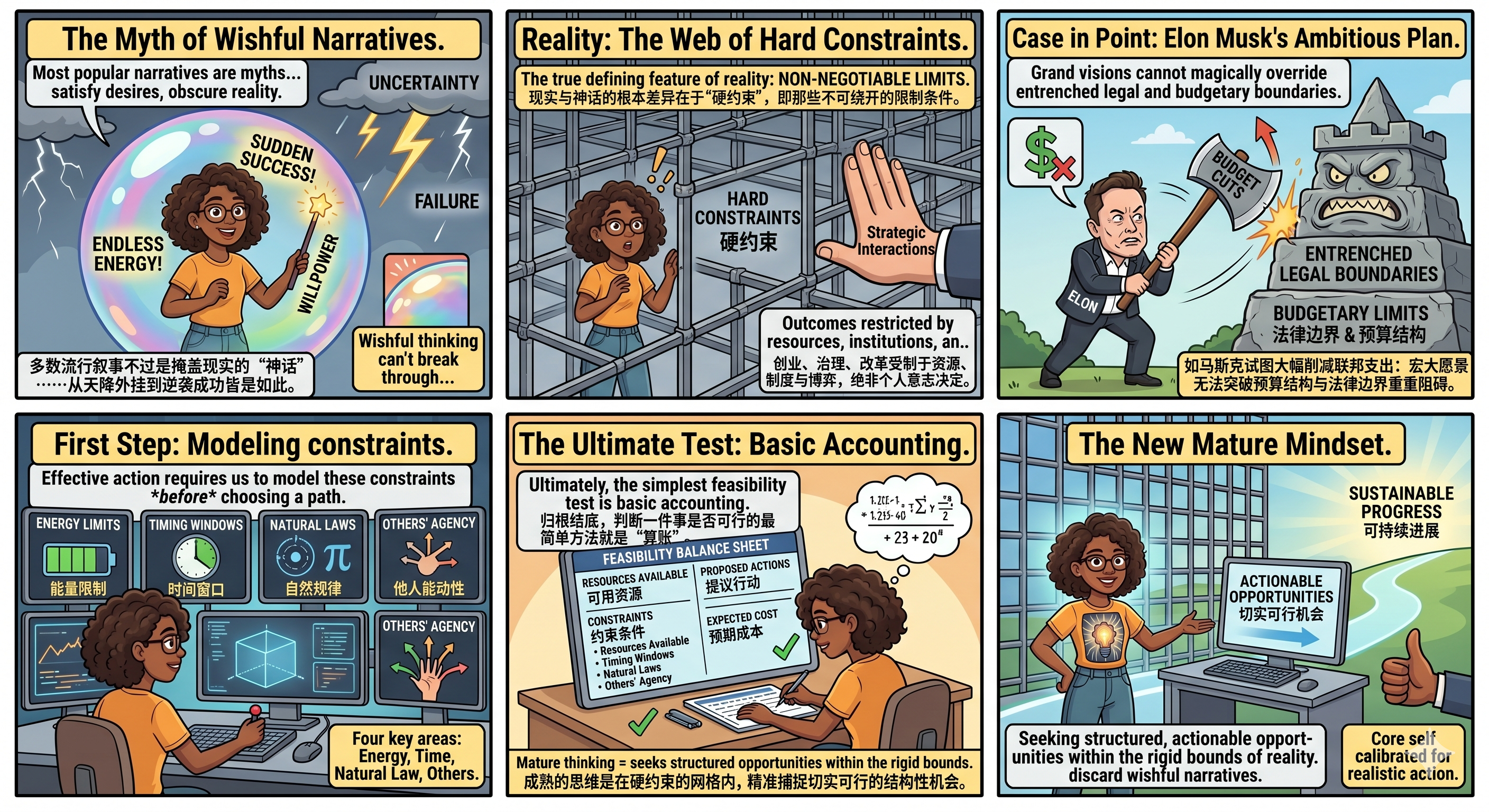
While the world is shaped by narratives, most popular ones function merely as myths—tales of sudden empowerment or effortless success that satisfy our desires but obscure reality. Even higher-level narratives that acknowledge uncertainty and failure often retain illusions of meaning. The true defining feature of reality, however, is the presence of “hard constraints”: non-negotiable limits that cannot be bypassed. Whether in business, governance, or systemic reform, outcomes are inevitably restricted by resources, institutions, and strategic interactions rather than dictated by sheer intention. For instance, Elon Musk’s ambitious attempt to cut U.S. federal spending illustrates that grand visions cannot magically override entrenched legal and budgetary boundaries. Therefore, effective action requires us to model these constraints before choosing a path, paying special attention to four critical areas: energy limits, timing windows, natural laws, and the agency of others. Ultimately, the simplest feasibility test is basic accounting; mature thinking means discarding wishful narratives in favor of seeking structured, actionable opportunities within the rigid bounds of reality.
Fifth: Possibility
This world will not give you absolute certainty; instead, meaning is generated by uncertainty. Don’t just seek stability—learn to manage, embrace, and even leverage uncertainty.
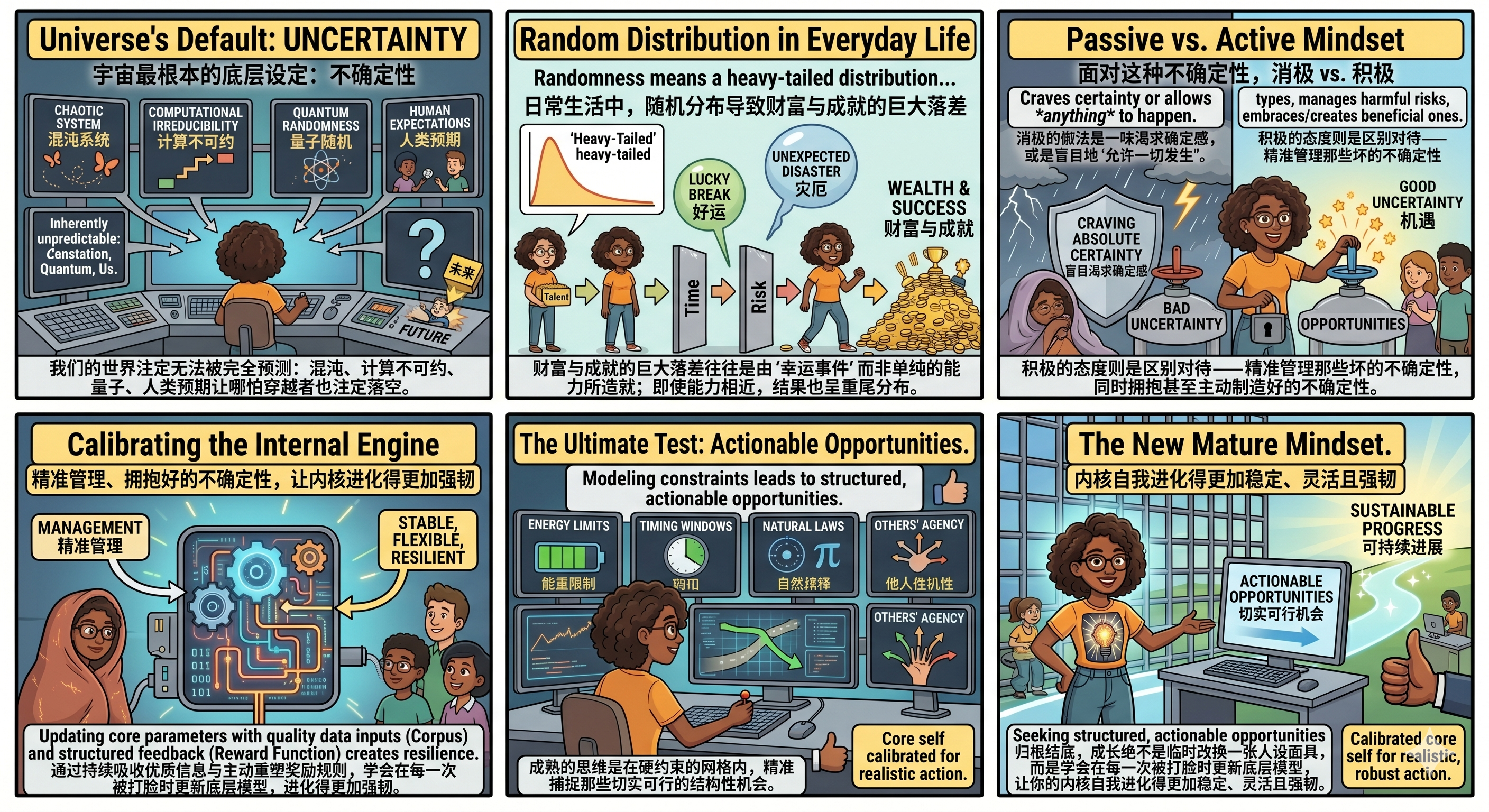
Uncertainty is the universe’s most fundamental feature and the very fuel that gives human life meaning. The world is inherently unpredictable: chaotic systems are extremely sensitive to initial conditions, computationally irreducible systems must evolve step by step, quantum events are intrinsically random, and human expectations constantly alter the rules of the game—rendering even a time traveler’s predictions useless. In everyday life, this randomness means that wealth and success follow a heavy-tailed distribution driven more by lucky breaks or unexpected disasters than by pure ability, leading people with similar talents to vastly different outcomes. Faced with this reality, a passive attitude either craves absolute certainty or simply “allows anything to happen.” Conversely, an active stance distinguishes between types of uncertainty, managing the harmful risks while embracing—and even actively creating—the beneficial ones. Ultimately, when the fleeting moment of turning the “uncertain into certain” becomes our source of meaning, we realize that it is precisely this unpredictability that gives our narratives and lives their tension and momentum.
Sixth: Core
You do not have only one “self” but are driven by different layers of self; true growth is not about changing emotions or persona, but rewriting your core.
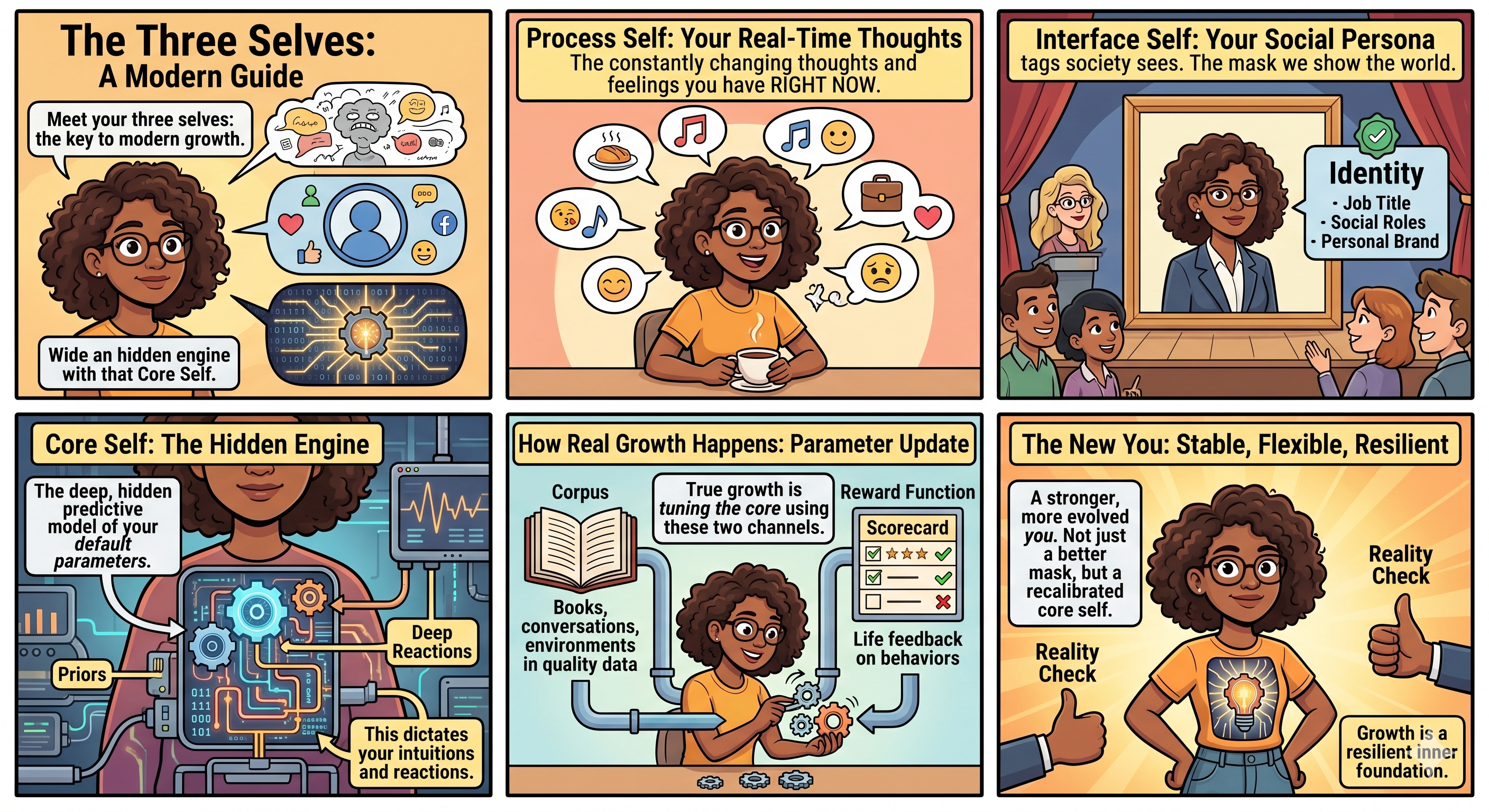
Modern individuals can best understand themselves through a “three-self” model. The process self represents your moment-to-moment stream of thoughts and feelings—the active “I” engaged in the present. The interface self serves as the relatively stable identity and persona within your personal narrative, which is the “I” that society recognizes. Deep beneath these lies the core self: an underlying, often unconscious predictive model of prior assumptions that functions as your “default parameters.” Ultimately, it is this core self that dictates your intuitions and deep-level reactions. True growth, therefore, is essentially the process of updating these parameters through two primary channels: the “corpus” of information you absorb—such as the stories, environments, and social circles that train your neural network—and the “reward function,” which is the feedback system evaluating your actions. Because the people you surround yourself with and the standards you accept gradually shape this internal model, authentic development isn’t about merely swapping masks. Instead, it requires continuously absorbing quality input and deliberately designing your reward systems, using every harsh reality check as a crucial opportunity to recalibrate your model into a more stable, flexible, and resilient version of your core self.
能耐需求定理 Power-Seeking Theorems #
Source:
- ① Alexander Turner’s 2021 research on AI agents;
- ② Theories in cognitive science and behavioral empowerment, such as Christoph Salge’s empowerment hypothesis;
- ③ The principle “the gentleman is not a mere instrument” in traditional Chinese thought, and Kant’s moral philosophy that humans are ends in themselves, not means.
Definition:
The power-seeking theorem states: In uncertain environments, agents (including humans) are most likely to achieve long-term goals and growth by increasing their future options and capabilities. In short, don’t just pursue a single reward—actively enhance your abilities and degrees of freedom.
Application:
Understanding this theorem means: consider more options in decisions, avoid path dependence on old narratives; add roles to your identity, don’t be trapped by a fixed one; learn not just specific tools but transferable understanding; maintain independence in social relations, avoid total dependence on a single power source.
Insight:
The real difference between a gentleman and a petty person is being proactive vs. reactive.
身份认同 Identity #
Source:
- ① Robert Kegan’s Constructive-Developmental Theory of adult mental development;
- ② Daniel Dennett’s framework of the intentional, design, and physical stances.
Definition:
Identity is an individual’s sense of belonging to a social role or group, shaping behavior, values, self-perception, and social interaction. Advanced identity means using identity as a tool, not being bound by it, enabling self-direction and mental growth.
Application:
Mastering identity means: proactively set and switch identities, avoid being driven by a single one; empower actions in social, work, and learning contexts; reconstruct others’ identities to reduce conflict and friction.
Insight:
Advanced players treat identity like clothing: wear what’s appropriate for the occasion, and hang it up at home.
Image content:
Shows the process from “impotent rage” to “changing perspective” and becoming an “aloof observer”; compares politicians to bacteria and oneself to a microbiologist recording interesting behavior patterns.
安全感 Security #
Source:
- ① Mary Ainsworth’s Attachment Theory;
- ② John Bowlby’s “secure base” and “safe haven” model;
- ③ Amy Edmondson’s research on psychological safety.
Definition:
Security is an individual’s stable sense of trust in their environment and relationships, the most basic human need. It enables exploration and creativity, and saves cognitive bandwidth. Advanced security means being able to support oneself and also be a source of support for others.
Application:
Recognize your attachment style, identify anxious or avoidant patterns, reduce old emotional burdens; build a self-harbor (self-compassion) and a controllable environment; provide a secure base and safe haven in relationships, enhance others’ exploration and psychological safety, and gain strong social capital.
Insight:
Security is the prerequisite for exploration, and exploration determines the breadth of one’s life journey.
Image content:
Shows the concepts of “THE BASE” (secure base), “THE HARBOR” (safe haven), and “UNITY & LOYALTY”. Emphasizes being a source of security for others, supporting bold attempts, providing companionship and support, and protecting your own people.
赛道选择 Game Selection #
Source:
- ① The biological concept of Niche Construction;
- ② Saras Sarasvathy’s Effectuation theory.
Definition:
Game selection is a mental tool for choosing which “game” to participate in within society and career. Choosing different tracks means taking on different rules, risks, and growth paths. Advanced game selection skills can make effort yield exponential amplification, rather than mere repetitive labor or pursuit of stability.
Application:
Identify the track that suits you, build your niche based on your resources and abilities, create unique value; use effectuation thinking to iteratively combine resources at hand and discover or create new opportunities.
Insight:
The greatest fear is fantasizing about great achievements while stuck in the system, or longing for the system’s stability while living in a multiplicative world.
图片内容 Image content:
Uses a soccer match as an example: experts can see changes in the “probability structure”. Key assists (breaking through the defense) move the ball from a low-probability scoring area to a high-value area, instantly reversing the situation. The most valuable moment is the one that changes the game.
场域理论 Field Theory #
Source:
- Proposed in the 1970s by French sociologist Pierre Bourdieu.
Definition:
Field theory views society as composed of multiple relatively independent “fields,” each a network of relationships or a competitive arena. Position, resources, and rules within a field determine success or failure. Success depends not only on ability or effort, but on understanding and following the field’s orthodox beliefs and habits.
Application:
Identify the structure and key positions of your field, understand the field’s default beliefs and rules; reflect on your own habits to judge compatibility with the field; accumulate capital valued by the field; strategically choose to adapt to or change the field to achieve growth and influence.
Insight:
Effort is not hard currency; compliance is.
Image content:
The field is depicted as a vast network of relationships. Introduces Doxa (orthodox beliefs: invisible but omnipresent rules), habitus (internalized default settings), and capital (chips within the field, such as social and cultural capital). Emphasizes that survival in the field requires mastering the rules of the game.
探索与利用 Explore / Exploit #
Source:
- ① The multi-armed bandit problem in computer science and decision theory;
- ② The Gittins index proposed by mathematicians.
Definition: Explore vs. Exploit is the strategy of balancing “trying new things (exploration)” and “deepening known advantages (exploitation)”: exploration discovers opportunities, exploitation creates value, and the combination leads to sustained growth and vitality.
Application:
When choosing a career or learning direction, first explore different opportunities, then deepen strengths; in art or project management, try diverse approaches, then focus on effective strategies; maintain novelty and continuous learning to extend vitality and growth.
Insight:
First explore, then exploit; after achieving results through exploitation, explore again, then exploit again.
图片内容 Image content:
Uses a painter as an example: the first stage is diverse exploration, resulting in messy works; the second stage is exploitation after capturing a unique style, with quality soaring into a winning streak; the third stage is starting a new round of exploration after exploitation. Emphasizes the cycle of “explore -> exploit -> explore”.
共鸣 Resonance / Resonanz #
Source:
- Proposed by Hartmut Rosa (1965–) in the mid-to-late 2010s.
Definition:
Resonance is the mutual response and resonance between independent subjects, accompanied by a sense of mission. It means you are not just outputting, but receiving feedback in interaction. Resonance is divided into: “horizontal resonance” (between people), “diagonal resonance” (between people and things or work), and “vertical resonance” (between people and something greater).
Application:
Transform comparative narratives in life into resonance narratives, such as sharing experiences or achieving goals together; find resonance points in career, art, or daily life to combine mission and joy.
Insight:
Resonance requires you to allow the world to have its own voice: let materials talk back, let children be disobedient, let the market slap you, let a relationship take you somewhere you didn’t plan.
Image content: 对比了“比较”与“共鸣”。比较会带来嫉妒、傲慢和焦虑,让人滑向排序的深渊;共鸣则带来感动、宁静与连接。强调将关注点从“排序”转向“校准”,关注频率而非振幅。
Compares “comparison” and “resonance”: comparison brings jealousy, arrogance, and anxiety, leading to the abyss of ranking; resonance brings emotion, calm, and connection. Emphasizes shifting focus from “ranking” to “calibration,” and paying attention to frequency rather than amplitude.
供给侧心态 Supply-Side Mindset #
Source:
- ① Economics, Game Theory, and positive-sum thinking;
- ② Jon Levy’s 2025 book Team Intelligence.
Definition:
Supply-side mindset means treating yourself as a module that provides verifiable value, proactively reducing collaboration friction, and embedding yourself in long-term repeated games and network effect structures. It emphasizes: ① Value creation: you must truly solve problems, not just talk; ② Friction elimination: make it easier and smoother for others to work with you; ③ Network reach: what level of collaborative circles you can access.
Application:
- Workplace: demonstrate problem-solving ability, provide practical solutions;
- Family and close relationships: optimize division of labor and processes, improve overall happiness;
- Global and policy: supply technology, standards, and systems, rather than zero-sum competition for resources.
Insight:
In this highly interconnected, information-replicable, and complementary modern society, “being needed” is safer than “owning”.
复利 Compound Interest #
Source:
- ① Thomas Piketty’s discussion of r > g in Capital in the Twenty-First Century;
- ② Pierre Bourdieu’s theory of multiple forms of capital.
Definition:
Compound interest means interest is calculated not only on the principal but also on accumulated interest, forming exponential growth over time. It applies not only to money but also to knowledge, skills, health, relationships, and other forms of capital. The key is to start early and persist long-term to form an uncatchable advantage.
Application:
Compound interest helps accumulate wealth in financial investment and accumulate various forms of capital in personal growth: invest in human capital (knowledge, skills) in youth; deepen expertise, reputation, and social capital in middle age; focus on health, experience transfer, and influence in later years; ROI determines accumulation priority.
Insight:
Interest rate is on you, compound interest grows in the system.
自我决定理论 Self-Determination Theory #
Source:
- First proposed as a framework by Edward Deci and Richard Ryan in the 1980s.
Definition:
Self-determination theory states that human motivation ranges from external control to full autonomy. High-quality motivation comes from autonomy, competence, and relatedness, not just external rewards. Highly agentic people can actively choose, decide, and shape their lives.
Application:
- ① Managers, teachers, or parents can foster agency by providing choice, challenge and feedback, and relationship support;
- ② individuals can enhance self-drive by internalizing task meaning, making micro-decisions, and gamifying tasks;
- ③ high agency helps create flow, achieve long-term learning, innovation, and excellence.
Insight:
The strongest force is not self-discipline, but willingness.
自由能原理 Free Energy Principle #
Source:
- First proposed around 2005 by Karl Friston.
Definition: The free energy principle holds that living beings maintain structure and boundaries by minimizing “free energy” (roughly equivalent to surprise), i.e., by actively predicting the environment and adjusting themselves or the environment to survive and remain stable.
Application:
- ① Individuals reduce surprise through perceptual and active inference, achieving efficient learning, habit improvement, and psychological stability;
- ② Organizations and companies lower system free energy by collecting information, adjusting strategies, and actions to maintain adaptability;
- ③ Education and behavior design can provide controllable surprise and environmental stability to improve attention and learning efficiency.
Insight:
To live is to align yourself with the environment in both directions.
主动高认知负荷 Active High Cognitive Load #
Source:
- Developed from the Cognitive Load Theory (CLT) proposed in 1988 by John Sweller.
Definition:
Active high cognitive load is a thinking mode that deliberately mobilizes a large amount of attention resources to handle complex, high-uncertainty tasks. It increases germane load, enabling the brain to build, integrate, and optimize internal models, thus entering flow and improving output and learning efficiency.
Application:
In study or work, occupy working memory with difficult tasks to achieve deep thinking and constructive learning; in daily life, upgrade ordinary activities to analysis, reasoning, or reverse engineering tasks to create cognitive challenges; in organizations and project management, improve team attention allocation and complex problem-solving ability.
Insight:
Active high cognitive load means not waiting for the world to give you problems, but turning the world itself into a problem.
WOOP Wish-Outcome-Obstacle-Plan #
Source:
A set of cognitive strategies popularized by Gabriele Oettingen.
Definition:
WOOP is a thinking process that turns wishes into executable actions. Through mental contrasting and implementation intentions, it awakens the brain from a drifting state and enables proactive decision-making. The four steps are: Wish: clarify the goal you want to achieve; Outcome: imagine the specific feelings and benefits after achieving the goal; Obstacle: identify the most likely internal obstacles in the process; Plan: design executable plans for each obstacle.
Application:
Helps individuals reduce on-the-spot decisions in life, study, and work, improve task accuracy; bind situational triggers to action plans to automate key behaviors and reduce procrastination; support calm and effective action under high pressure or low control.
Insight:
WOOP turns the drifter’s unsolvable problem into the next solvable step; it’s a technique for regaining some control in an uncontrollable life.
认知解耦 Cognitive Decoupling #
Source:
① Keith Stanovich’s research on slow thinking and cognitive decoupling; ② Lisa Feldman Barrett’s theory of constructed emotion; ③ Modern emotion regulation research, such as James J. Gross’s cognitive reappraisal theory.
Definition: and 行动的主动控制力。
Cognitive decoupling is the ability to separate “the narrative in your mind” from “the facts before your eyes,” thus regulating negative emotions. It works by recognizing the difference between perception and reality, taking others’ perspectives, and reassigning meaning to events, breaking the chain of automatic emotional reactions and giving individuals active control over emotions and actions.
Application:
Prevent emotional rumination, reduce stress and health damage; maintain rational judgment in complex interpersonal and social situations; reappraise negative events as constructive opportunities to guide positive action; enhance metacognition so individuals can observe their own thinking rather than be controlled by emotions.
Insight:
You can use cognitive decoupling to let some emotions arise and dissipate without getting on the train and following them.
图片内容 Image content:
Shows the process of handling criticism in a meeting through cognitive dissociation, perspective-taking, and cognitive reappraisal. The instinctive reaction “he denies my whole self” is broken down into the fact “the other party thinks the work needs to be redone,” and “attack” is reappraised as “a need to align on quality.”
无免费午餐定理 No Free Lunch Theorem #
Source:
Originating from algorithm optimization theory in computer science, proposed in 1997 by David Wolpert and William Macready.
Definition:
The No Free Lunch Theorem states: there is no universally optimal decision or algorithm. Any method that performs well in a specific domain will necessarily perform poorly in others; optimization comes at a cost, and the effectiveness of decisions depends on individual biases and prior assumptions.
Application:
Understand that there is no universally optimal decision in life and work; emphasize that decisions must first set values and biases, clarify goals and domains; conduct research, reasoning, and action under limited information and uncertainty; guide individuals to actively choose in adventures and adjust or exit decisions when necessary.
Insight:
All things are impermanent, and decisions are always biased.
图片内容 Image content:
Compares the No Free Lunch Theorem to a scientific version of “Buddhist dharma”: “all conditioned phenomena are suffering”—to gain, you must give up; pursuit inevitably brings imperfection. To live in the world, you must accept imperfection and move forward in impermanence.
概率分布 Probability Distribution #
Source:
① Foundations in statistics and probability theory; ② Research on outcome bias in psychology; ③ Decision theory and behavioral economics, such as Thinking in Bets by Annie Duke; ④ Practical case studies in decision systems, such as systematic thinking by Scott Adams.
Definition:
Probability distribution is a mathematical function describing the possible outcomes of a decision or event and their probabilities. It focuses not only on single outcomes but on the full range of future possibilities. The core of decision-making is not to pick the single “best” outcome, but to manage the overall distribution and understand the uncertainty of risks and opportunities.
Application:
Decision-makers analyze probability distributions rather than single outcomes to evaluate strategies; manage tail risks and volatility in career choices, investment, healthcare, insurance, etc.; build and optimize systematic behaviors or skill accumulation, focusing on long-term probability distribution optimization; help cultivate stable, rational decision temperament, and avoid overreacting to random outcomes.
Insight:
After the arrow leaves the string, whether it hits the target or not, you must maintain a certain calm indifference—because that’s a sample of wind and noise.
图片内容 Image content: Uses the example of monk Jueyuan facing life choices: Path 1 “retreat to the mountains” has very low variance and is extremely stable; Path 2 “take the civil service exam” has huge variance and a heavy tail, possibly leading to wealth or great risk; Path 3 “wander the world” is too random. Emphasizes that decision-making is about managing your future distribution, involving expected value, variance, and tail risk.
贝叶斯主义 Bayesianism #
Source:
- A probability formula proposed in the eighteenth century by Thomas Bayes.
Definition:
Bayesianism holds that probability is a measure of belief, not an attribute of objective things. It uses “prior” to represent your original judgment, updates the prior with “evidence” to obtain the “posterior” probability. Decision-making and reasoning are based on continuously updating beliefs, not just single outcomes or appearances.
Application:
Daily decisions: judge health risks, investment opportunities, colleague reliability, etc.; risk management and strategy optimization: combine priors and evidence to avoid extreme overreactions; individual cognition: train rational thinking, keep room for “maybe I’m wrong,” avoid rigid or absent priors.
Insight:
Priors are both our wealth and our cage.
Image content:
Compares “frequency vs. belief”: frequentists see frequency as objective truth, requiring infinite repetition; Bayesians see probability as subjective belief, quantifying uncertainty. Emphasizes that in unrepeatable reality, use prior knowledge and new evidence to continually update the posterior: “prior + evidence = posterior”.
信息价值 Value of Information (VOI) #
Source:
Originating in the mid-twentieth century, representing a paradigm shift in statistics and management science.
Definition:
Value of information refers to the usefulness of information for actual decision-making: only when information can change your action does it have value. It measures the average additional gain from making the best choice with information versus without it.
Application:
Prediction markets and arbitrage: capture high-value information for stable returns; business management: focus on internal bottlenecks, process optimization, and key decision data, not just macro news or hot topics; personal life: choose information that improves key actions, not just to satisfy curiosity or fear of missing out.
Insight:
It’s fine to be a “knowledge person,” but if you want to get things done, you need VOI awareness.
Image content:
Compares the “drifter” trapped in hot news, latest updates, and FOMO with the “sage” who has VOI awareness. Emphasizes that consuming information is not action; only information that changes decisions and guides action has value, otherwise it’s just noise.
凯利公式 Kelly Criterion #
Source:
- The 1956 paper A New Interpretation of Information Rate by John L. Kelly Jr. of Bell Laboratories.
Definition: ③ The Kelly Criterion is a formula for calculating the optimal bet size in uncertain, repeatable, multiplicative environments. It uses win probability, odds, and cognitive advantage to decide how much to invest each time, maximizing compound growth over the long term while avoiding bankruptcy.
Application: ③ The Kelly Criterion turns cognitive advantage into action size: increase investment when you have an edge, don’t bet when you don’t. It can be used for investment decisions, career choices, time allocation, and trust management; the core is to size positions based on the advantage, pursuing long-term compound growth rather than single wins or losses.
Insight: ③
From the Kelly Criterion’s perspective, the fundamental freedom in life is always having the ability to make the next bet.
Image content:
Background: Bell Labs in 1956. Kelly transformed the communication noise problem into a gambling scenario and derived the optimal bet formula f* = (bp - q) / b. Emphasizes that the Kelly Criterion is the combination of information theory and capital compounding, and that growth is limited by cognitive bandwidth.
非遍历性 Non-ergodicity #
Source:
① Ergodicity theory in statistical physics and probability theory; ② Research on economic systems by physicist Ole Peters; ③ Analysis of time averages versus ensemble averages by Murray Gell-Mann; ④ Discussions on risk theory by Nassim Nicholas Taleb.
Definition:
Non-ergodicity means that the average result of a system as a whole does not represent the true fate of individuals over time. In multiplicative growth environments, the ensemble average may be positive, but the time average experienced by individuals may keep declining or even lead to ruin.
Application:
In investment, entrepreneurship, and other multiplicative worlds, individuals must control variance and avoid going to zero: reduce frequent trading, use barbell strategies or Kelly sizing, diversify risk through index investing or risk sharing, thus lowering the probability of ruin from non-ergodicity.
Insight: ③
The multiplicative world is full of non-ergodicity risk, which is bad for individuals but good for the house.
Image content:
Uses Bitcoin investment as an example: shows how price volatility from 2015 to 2026 affects different investors. Emphasizes that non-ergodicity explains why those who don’t care about short-term volatility, have a long-term mindset, or strong financial resources are best suited for investing, and that a single wipeout can bring ordinary people to zero.